
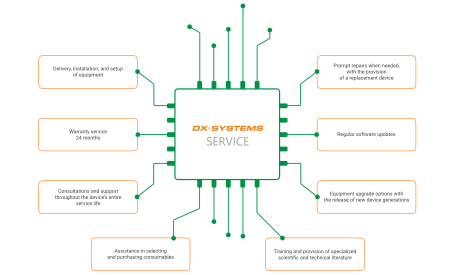
Доставка монтаж і
налагодження

Гарантійне обслуговування  мінімум 24 місяці

Консультації та підтримка протягом  усього терміну експлуатації
приладу

Ремонт у разі потреби у найкоротші  терміни з наданням підмінного приладу

Постійні оновлення програмного забезпечення

Можливість модернізації| обладнання після виходу нових поколінь приладів

Допомога у підборі та закупівлі витратних матеріалів

Інструктаж та постачання спеціальної наукової та технічної літератури

Questions & Answer

How to Prepare for Installation?
  1. Prepare the examination room:
  • Power supply. The best option is a dedicated power line from the distribution board, without other devices connected. Grounding must be ensured (NOT neutralization). Alternatively, a grounded outlet is acceptable if the building’s electrical system is properly installed.
  • Lighting. The room should allow window and light dimming (for EEG and EP). It is also not recommended to use fluorescent lamps, as they may create interference with signal recording.
  • For the doctor. Desk for a desktop PC or laptop, chair.
  • For the patient. Couch (for EMG). Chair where the neck and legs can be fully relaxed (for EEG and EP). Bed, if sleep monitoring will be performed.
  • Device placement. The device should be placed as far as possible from power cables and high-consumption electrical devices, and not closer than 1.5 m. In special cases (e.g., close proximity to MRI or X-ray equipment), the device must be moved to another room.


  1. Prepare the PC for device software installation (if computer equipment is not included in the supply agreement, please arrange purchase in advance):
  • Recommended specs: Intel Core i5, 3.2 GHz / 16 GB RAM / 512 GB SSD.
  • If another configuration is available/purchased, please confirm specifications with our technical support.
  • Stable internet connection.
  • Remote access software.
  • Viber or Telegram.
  • 24″ monitor (recommended even if using a laptop); an additional monitor is required for EMG with EP mode using a reverse chess pattern.
  • Printer.
  • Phillips screwdriver, hex keys (4 and 5 mm).

Various types of noise (artifacts) can appear in EEG recordings, which are not related to brain activity and may distort the results. The main causes include:

  1. Biological artifacts (from the patient):
  • Muscle activity (EMG artifacts) – tension of facial muscles, chewing, smiling, jaw clenching.
  • Eye movements and blinking – create large slow waves that may resemble pathology.
  • Electrocardiogram (ECG artifact) – electrical potentials of the heart may sometimes appear on the EEG.
  • Breathing, coughing, body movements – cause fluctuations in the recording.
  • Sweating – alters electrode-to-skin contact, resulting in slow waves.
  1. Technical artifacts (equipment):
  • Interference from the power supply (50 Hz).
  • Mechanical vibrations of the equipment or cables.
  1. External factors:
  • Metal objects, mobile phones, or electrical devices nearby.
  • Insufficient shielding of the room from electromagnetic fields.
Noise type How it looks at EEG Cause
Blinking, eye movements (EOG) Large slow waves, in frontal leads Eye opening/closing, eye movement
Muscle (EMG artifacts) Fast “spiky” waves, high-frequency background Facial muscle tension, chewing, talking
Cardiogram (ECG artifact) Rhythmic waves corresponding to heart rate Electrical activity of the heart
Body movements, coughing, breathing Irregular waves, baseline shifts Trunk or shoulder movements, breathing
Sweating Slow waves, instability Moist skin, change in impedance
Poor electrode contact Spikes, flashes, shifts High impedance, dried gel, electrode displacement
Power line interference Sinusoidal waves at 50 Hz Electrical appliances, poor shielding
Mechanical artifacts Irregular oscillations, noise Wire movement, device vibration
  1. Patient preparation
  • Explain the need to relax and remain still.
  • Hair should be clean and free of styling products.
  • If possible, avoid caffeine, energy drinks, and medications (as approved by the doctor).
  1. Control of biological artifacts
  • The patient should not chew or clench their jaw.
  • Comfortable position (sitting or lying down).
  • Ensure the patient can sit calmly with eyes closed.
  1. Working with electrodes
  • Use fresh gel/paste.
  • Impedance <5 kΩ, with minimal difference between electrodes.
  • Electrodes should be firmly but comfortably secured.
  1. Technical considerations
  • Turn off phones and unnecessary devices.
  • Avoid cable movement.
  1. Room conditions
  • Quiet, dim lighting.
  • Comfortable temperature (no sweating).
  • Minimal distractions.
  1. Biological artifacts (from the patient):
  • Patient movements – even small movements can cause significant signal distortion.
  • Tremor, muscle tension – produce high-frequency “noise” that can mask real activity.
  • Cardiogram (ECG artifact) – electrical potentials of the heart may sometimes overlap with EMG.
  • Cross-talk from neighboring muscles – when electrodes pick up signals from other muscles.


  1. Technical artifacts (equipment):
  • Poor electrode contact (insufficient skin preparation, dried gel, electrode movement).
  • Power line interference (50/60 Hz).
  • Mechanical vibrations, cable movements – produce recording noise.


  1. External factors:
  • Nearby electrical devices.
  • Insufficient shielding of the room.
Noise typeHow it looks at EMGCause
Biological: patient movementsIrregular wavesInsufficient muscle relaxation, body movements
Tremor, muscle tensionFast oscillationsInvoluntary muscle activity
ECG artifactRhythmic waves, matching heart rateHeart activity
Cross-talk from neighboring musclesAdditional oscillationsSignal from nearby muscles
Poor electrode contactSpikes, signal distortionWeak contact with the skin
Power line interferenceSinusoidal waves at 50/60 HzElectrical devices, poor grounding
Cable movement, vibrationsIrregular oscillationsMechanical interference
  1. Patient preparation
  • The patient should be in a relaxed state.
  • If possible, avoid caffeine and stimulants before the examination.
  • Skin at the electrode sites should be clean and free of oils.
  1. Control of biological artifacts
  • The patient should sit/lie still and avoid movement.
  • Ensure there is no excessive muscle tension.
  • For tremor, record in short series, taking the patient’s condition into account.
  1. Working with electrodes
  • Use fresh gel/paste.
  • Clean the skin thoroughly (alcohol/gel).
  • Ensure reliable contact and secure electrode placement.
  1. Technical considerations
  • Turn off nearby electrical devices and phones.
  • Make sure cables do not move during recording.
  1. Room conditions
  • Quiet environment with minimal distractions.
  • Comfortable temperature (no excessive sweating).
  • Patient in a comfortable position to avoid involuntary movements.

Request a Consultation

When you purchase medical equipment from our company, you automatically gain unlimited access to consultations on all aspects of operating our devices.

You can contact us in any convenient way: by phone at  +38 (067) 572-49-49, by email, or via messaging apps.

Have Questions?

Speak with our experts and get professional guidance.

Request a call